


Goal: help you choose, understand, and start playing this low-pitched instrument with a practical approach suited to the French market.
You will learn the baritone’s role in an ensemble, how it differs from the alto and tenor, ergonomic considerations such as weight and harnesses, how to choose between student and professional models, and what to budget.
In brief: a large E-flat instrument with a low register. It supports the harmony and can also play solos.
What this guide offers: help avoiding common mistakes—reeds and mouthpieces that are too demanding, poor posture—playing your first notes, and making a sound choice when buying new or used.
Who this is for: adult beginners, older teenagers, and alto or tenor players who want to explore more of the saxophone family. Big bands and low voices are attracting renewed interest in both jazz and classical music.
What to expect: practical advice, price guides, and simple checklists for before and after purchase, to help you make an informed choice and build a solid foundation.
Why choose a baritone saxophone today?
Its low E-flat register gives any ensemble a distinctive foundation.
Musically, the instrument binds the wind section together and reinforces the bass. It adds depth to harmonies without covering other voices. Its parts range from bass lines and countermelodies to riffs and walking bass lines.
Where it is used
It is most common in big bands and jazz ensembles, but also appears in concert bands, marching bands, and film scores. Classical music has historical examples too, including its use in some orchestral sections as early as 1844.
Its role compared with the tenor and alto
Fingerings are similar across the family, but breath support and the instrument’s place in an arrangement change.
| Role | Examples of use | Key characteristic |
|---|---|---|
| Bass line | Big band, jazz | Low foundation and projection |
| Countermelodies and riffs | Orchestras, film scores | Harmonic depth |
| Occasional soloist | Modern arrangements | Powerful tone |
Why now: if you already play in a group, baritone players are uncommon and in demand. Alto and tenor players can become more versatile by adding this register to their range.
Understanding the baritone saxophone and its place in the saxophone family
The saxophone family runs from high to low, with each instrument filling a different role in a group.
Members of the family: from soprano to contrabass
Main members: soprano, alto, tenor, and baritone saxophones.
Rarer members include the sopranino, bass, and contrabass saxophones.

Transposing instruments: what this means when reading music
Saxophones are transposing instruments. Their music is written in treble clef, but a written note does not always sound at the same pitch.
A practical example: a written C on an E-flat baritone sounds as concert E-flat. Pay attention to the part you are reading and to tuning with the other sections.
| Type | Tone | Transposition |
|---|---|---|
| Soprano saxophone | High, clear | B-flat / sounds a major second lower |
| Alto | Midrange, rich | E-flat / sounds a major sixth lower |
| Baritone | Low, deep | E-flat / sounds an octave plus a major sixth lower |
Tip for musicians: understanding transposition helps you choose an instrument that complements your repertoire. You do not need to master it before you start; it matters most when playing with an ensemble.
How a saxophone works: useful basics before buying
Understanding how the sound is made helps you assess an instrument when you try it.
Reed, mouthpiece, and air column: where the sound begins
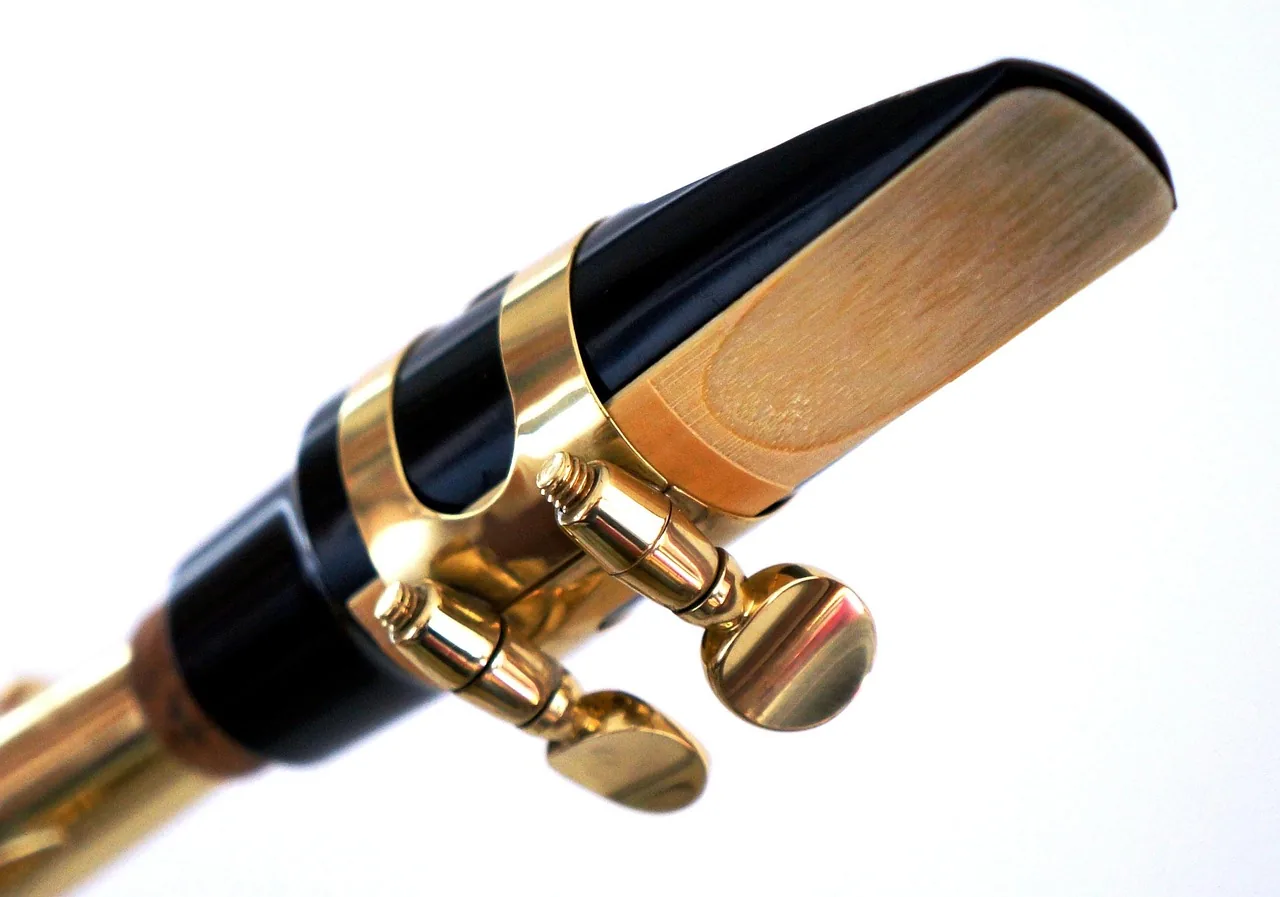
Sound begins when the reed, held to the mouthpiece by the ligature, vibrates against it. That vibration sets the air column inside the instrument in motion.
Why it matters: a well-matched mouthpiece and reed make notes easier to start and sustain. Try several combinations; the instrument’s body affects its sound, but the mouthpiece often makes a greater difference to how easily you can produce it.
Octaves, harmonics, and tone
The octave key lets you move into the upper register by changing how the air column vibrates.
The baritone’s large air column calls for more breath support. It produces greater resistance and rich harmonics that give the sound its depth.
“On a low-pitched instrument, an even sound across the registers is essential.”
Practical things to test
- Check how easily low notes start and how smoothly you move into the upper register.
- Listen for an even sound across the registers and check for leaks.
- Try several mouthpieces and reeds; vary the tip opening and reed strength to assess stability.
For practical learning advice, see how to learn the saxophone.
Anatomy and ergonomics: what makes the baritone unique
The ergonomics of a low-pitched instrument directly affect how long and how well you can practise. On an instrument this large, weight distribution, hand position, and mechanical precision make a considerable difference.
Parts and key features
The instrument consists of the neck, body, bow, and bell. On a low-pitched instrument, the neck often loops so the instrument can be shorter without reducing its acoustic length.
Its keywork generally has 18 to 22 keys. On a larger instrument, careful key alignment and well-maintained pads are especially important to prevent leaks and unresponsive notes.
Weight, size, and support
Expect a weight of around 5.4 to 6.8 kg. You may feel it after a few dozen minutes: a simple neck strap can strain your neck, while a harness distributes the load and supports your back.
Posture, breathing, and checks in the shop
Keep your back straight, neck aligned, and arms relaxed. Good ergonomics support a steady air column: the right support lets you control your breath without raising your shoulders.
- Check that the thumb rests are comfortable.
- Try reaching the palm keys and low-note keys.
- Check that the neck is secure and the instrument balances well with the harness.
Baritone saxophone: a complete guide to getting started
The low register often suits motivated adults and musicians who already read music.

Who it suits
Suitable players: motivated adult beginners, older teenagers with a suitable build, musicians who can read music, and saxophonists seeking an ensemble role.
Moving from alto
The fingerings remain similar; learning mainly involves supporting the air column. You will also need to steady your embouchure and choose a softer reed at first.
Common mistakes and fixes
- Reeds that are too hard → choose a lower strength.
- A mouthpiece with too wide an opening or a clenched jaw → work on diaphragmatic breathing.
- Raised shoulders and a poorly adjusted harness → adjust its height to distribute the weight.
- Forgetting the swab → dry the instrument to prevent pad wear.
A two-to-four-week approach: practise briefly and regularly, hold notes for 10 to 15 seconds, play simple scales and articulations, then try short riffs in an ensemble setting.
| Player | Main challenge | Immediate adjustment |
|---|---|---|
| Adult beginners | Air volume and posture | Diaphragmatic breathing and a harness |
| Older teenagers | Physical strength and embouchure | A softer reed and short sessions |
| Alto or tenor players | Adapting to the low register | Adjust the mouthpiece and reed; practise note attacks |
| Ensemble saxophonists | Finding their place in the section | Group practice: rehearsals and jam sessions |
If you want resources on learning and selecting an instrument, see how to choose your first saxophone. These tips for getting started can help you overcome the challenges of an instrument that may be harder to master than it appears.
Comparing types of baritone saxophone
Different models suit different players, and priorities depend on how you play. Define your main use first, then compare the options using three clear criteria.

Student models: durability, simplicity, and manageable cost
Goal: learn with fewer complications.
These models emphasise durability and straightforward mechanics. They withstand frequent transport and need relatively little adjustment.
Their price is more manageable, making them suitable for a limited budget.
Professional models: advanced mechanisms, nuance, and projection
What to expect: expression and precision.
Professional models offer a more refined response, better projection, and smoother keywork. They often use higher-grade materials and finishes.
They cost more but provide a wider range of nuances.
Which features justify the extra cost for you?
Depending on how you play, these features may justify spending more:
- A high F-sharp key for solo or jazz playing.
- Comfortable left-hand keywork during rehearsals.
- A good neck and even response across registers for ensemble playing.
- Stable intonation within the section for orchestras and big bands.
| Use | Priority | Recommendation |
|---|---|---|
| Big band | Projection and attack | Professional or semi-professional model |
| Concert band or seated playing | Even response and comfort | Good student or semi-professional model |
| Jazz solos | Flexibility and tone colour | Professional model with a suitable mouthpiece |
Practical tip: prioritise airtight pads and reliable keywork. Experiment with mouthpieces and reeds to improve your tone before investing in a top-of-the-range model.
Materials, finishes, and their effects on sound and durability
Alloys and finishes can affect an instrument’s longevity and perceived tone colour.
Alloy characteristics
Yellow brass offers a clear attack and bright resonance. It can help with projection.
Gold brass tends to produce a somewhat darker palette, which may appeal if you want a rounder sound.
Red brass, with its higher copper content, can give a warmer, denser tone.
Lacquered and silver-plated finishes
Lacquer protects the instrument and makes everyday care easier. It also helps preserve its new appearance for longer.
A silver-plated finish appeals for its shine, but tarnish and fingerprints mean it needs more care.
What difference does this make in practice?
Materials can affect how an instrument responds and how its tone is perceived. But the mouthpiece, reed, and adjustment remain decisive.
Two brass instruments may sound different because of their bore, neck, or mechanics.
| Element | Effect on sound | Care |
|---|---|---|
| Yellow brass | Bright, projecting | Wipe regularly |
| Gold brass | Dark, round | A protective lacquer is recommended |
| Red brass | Warm, dense | Store dry; clean gently |
Quick tips: wipe the instrument after every session, store it somewhere dry, and tailor your trials to your repertoire: projection for jazz, an even response for classical music, and harmonic depth.
To compare models and their uses, see this practical resource: types and uses.
Price, budget, and brands: buying the right baritone saxophone
Before buying, consider what actually raises the price of a low-pitched instrument.
What increases the cost?
The brand‘s reputation, manufacturing precision and airtightness, keywork quality, and ergonomic features all affect the price.
A careful finish and durable replacement parts add to both longevity and cost.
Price guides for France
Expect to pay more than for an alto or tenor in the same range. Among new instruments, semi-professional models start at around €3,000.
For example, a lacquered-brass Jupiter JBS1000 costs around €3,200 and comes with a case, mouthpiece, mouthpiece cap, and ligature.
Brands to consider
- Jupiter — accessible value for money in France.
- SML Paris — local manufacturing and nationwide distribution.
- Other established names include Yamaha, Selmer, and Yanagisawa, depending on your budget and expectations.
New or used: what to check before buying
- Check pad condition and test low notes for leaks.
- Test key-rod movement, springs, and key alignment.
- Check the neck cork and look for dents in the bell and bow.
| Use | Priority | Recommendation |
|---|---|---|
| Ensemble or section | Stable intonation | Semi-professional or professional model |
| Recreation or learning | Durability | Good student model |
| Solo or jazz | Projection and nuance | Professional model with a good mouthpiece |
Buying strategy
Set a total budget for the instrument, accessories, and any servicing. Try two or three models using the same mouthpiece and reed.
Allow for hidden costs: an overhaul may be necessary and is often preferable to struggling with a poorly adjusted instrument.
To choose a suitable instrument, compare ranges and features first, then consult practical guides such as which saxophone to choose.
Essential accessories and everyday practice tips
Good equipment makes progress easier.
Your choice of mouthpiece affects how easily you produce a sound: a smaller tip opening makes a round tone easier to achieve and is often preferred in classical music. A larger opening offers more tonal variety but requires greater control, which can be useful in jazz.
Recommended reeds and strengths
Start with softer reeds. Aim for around 1 to 2.5 at first.
A reed that is too hard makes low notes difficult and causes unnecessary fatigue. Move to higher strengths when your air support and embouchure are stable.
Practical accessories
- A reliable ligature made of fabric, metal, or leather: it affects the reed’s vibration.
- A rigid case and a stable stand: they protect the instrument during transport and breaks.
- A music stand, chromatic tuner, and metronome: essential for working on intonation and rhythm.
Posture, tuning, and care
Keep your back straight and shoulders low, and use diaphragmatic breathing to maintain a steady sound.
To tune the instrument, push the mouthpiece farther onto the cork if the pitch is too low, and pull it out slightly if the pitch is too high. Check several notes.
“A short, regular routine: 15 to 20 minutes focused on tone, intonation, and rhythm.”
| Item | Function | Quick tip |
|---|---|---|
| Mouthpiece | Makes sound production easier | Start with a small tip opening |
| Reeds | Tone colour and resistance | Start with strength 1 to 2.5 |
| Accessories | Protection and practice | Rigid case, stand, tuner |
| Care | Pad longevity | Swab and wipe after every session |
Conclusion
For a choice that serves you well over time, focus on how you actually play and what feels comfortable. The baritone saxophone provides a low E-flat voice that is valuable in jazz and concert bands.
Before buying, define how you will use it, compare student and professional models, check its weight and ergonomics—including the harness—and test for leaks.
Remember: your mouthpiece and reed choice often has a greater effect on your first steps than the price difference between two similar instruments.
Care for the instrument regularly: keeping it dry and clean helps it stay in tune and makes learning easier. Alto and tenor players will recognise the fingerings but need to adapt their breathing and posture.
Try two or three instruments with the same reed, assess their projection, low register, and comfort, then make your choice with confidence.