

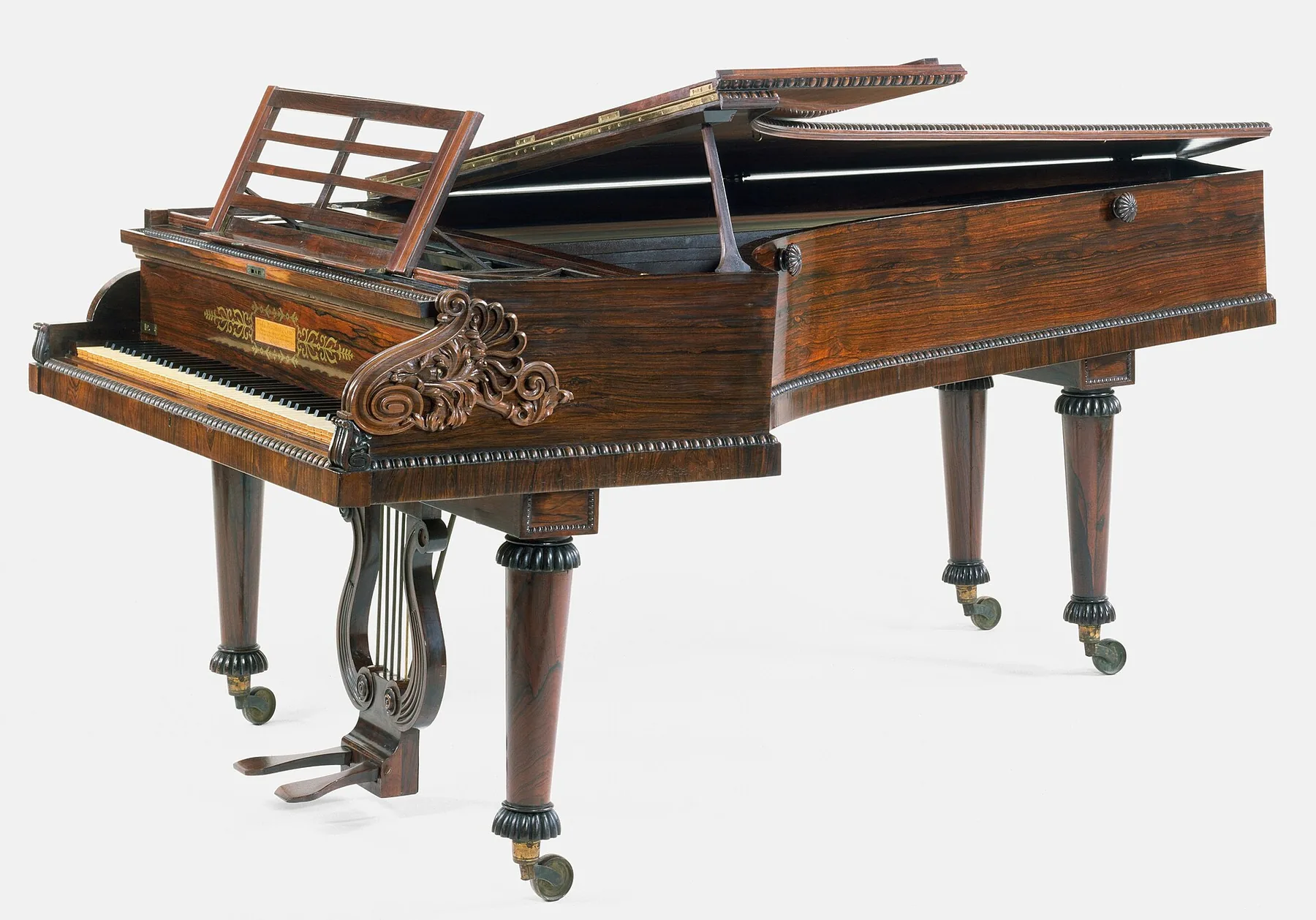
Classical piano music is an endless source of emotion and beauty. From the Baroque to the Romantic era, composers created pieces that continue to captivate music lovers around the world.
In this article, we invite you to discover an essential selection of pieces for piano, ranging from teaching pieces to virtuosic compositions. You will explore pieces such as Bach’s Prelude No. 1 in C Major and Beethoven’s Moonlight Sonata.
Some of these works, such as Schumann’s Kinderszenen, are ideal for beginners, while others, such as Liszt’s Liebesträume, challenge even the most accomplished performers. Each piece tells a story, evokes an emotion, and invites you on a unique musical journey.
Whether you are an experienced pianist or simply love music, this guide will take you into the heart of classical piano music. Are you ready to let these timeless pieces resonate within you?
Introduction and musical context
Classical music is a pillar of our cultural heritage, spanning centuries of history. It is distinguished by its rigorous structure and profound expressiveness, offering an incomparable richness of sound.
Definition and importance of classical music
Classical music encompasses several periods, including the Baroque, Classical, and Romantic eras. Each era brings its own characteristics and shapes the evolution of music. Carefully notated, this music reflects the ingenuity of legendary composers.
Historical and cultural influence
Classical music has shaped history and influenced the arts and society. From the Baroque to the Romantic era, it evolved alongside cultural and social changes while remaining a timeless source of inspiration.
Relevance in modern music education
Classical music plays a key role in contemporary music education. It provides a foundation for developing technical and artistic skills and gives pianists a deeper understanding of music.
Technical and artistic elements
Classical music stands out for its technical complexity and expressiveness. Forms such as the sonata and symphony, with their elaborate structures, showcase instrumental mastery and emotional depth.
Passing it on to new generations
Passing this musical heritage on to young pianists is essential. It preserves cultural heritage and inspires future generations to explore and innovate in music.
The most beautiful classical piano pieces: an essential selection
Classical piano music invites you on a journey through centuries of emotion and beauty. Each piece on this list was chosen for its ability to evoke deep feelings and offer a unique musical experience.
Criteria for selecting the works
These pieces were selected according to three essential criteria: accessibility, emotion, and artistic excellence. The works appeal to everyone, from beginners to experienced pianists. They stir intense emotion and display unparalleled artistic excellence.
Why these pieces appeal to French audiences
French audiences particularly appreciate the musical quality and emotional depth of these pieces. Classical composers created pieces that resonate with us and forge an intimate connection between performer and listener. These works continue to appeal through their emotional impact and their ability to convey universal themes.
You can discover these celebrated pieces in our complete selection through this link.
Baroque essentials
The Baroque era, with its decorative richness and intense expressiveness, left its mark on music history. One piece stands out in this context: Johann Pachelbel’s Canon in D.
A landmark example: Pachelbel’s Canon in D
Pachelbel’s Canon in D is a model of the Baroque style, famous for its contrapuntal structure and rich ornamentation. Composed in the seventeenth century, this work enjoyed a resurgence in popularity in the 1960s and became a fixture at ceremonies and receptions.
- Canon in D is distinguished by its canonic structure: several voices repeat the same theme, creating a complex and harmonious musical texture.
- Adapted for piano, this piece reveals elegant polyphony that is accessible to performers at every level.
- Played at weddings and formal events, it evokes an atmosphere that is both festive and solemn.
From its Baroque origins to the present day, Canon in D has endured for centuries, demonstrating the lasting appeal of classical music. Its timeless character makes it an essential piece that continues to inspire music lovers.
Bach’s legacy and his preludes
Johann Sebastian Bach, one of history’s greatest composers, left an indelible mark on classical music. His preludes, particularly Prelude No. 1 in C Major, remain cornerstones of piano study.
Prelude No. 1 in C Major and its educational benefits
Bach’s Prelude No. 1 in C Major is far more than a musical work. It is an exceptional teaching tool, ideal for improving rhythm and fingering. Its seemingly simple structure conceals a harmonic richness that captivates performers and listeners.
The beauty of this prelude lies in its captivating harmonic progression. It seems simple, yet offers the technical depth pianists need to refine their playing. In this work, Bach united emotion and teaching, providing a firm foundation for learning.
This prelude also bears witness to Bach’s legacy. It has influenced generations of musicians and remains an essential reference. Its use in teaching shows how alive and relevant Bach’s work remains.
Mozart’s genius at the piano
Mozart, an undisputed master of classical music, left an indelible mark through his piano compositions. His creativity and ingenuity shine through in celebrated works.
The Sonata in C Major and its distinctive features
The Sonata in C Major (K. 545), nicknamed the “Easy Sonata”, combines simplicity and depth. Composed for beginners, it reveals a rich harmonic structure, a captivating theme, and a melodic progression that engages performers and listeners alike.
Professional performers bring out the subtleties of this sonata through expression that takes the work beyond its apparent simplicity.
Eine kleine Nachtmusik: a fresh interpretation
Eine kleine Nachtmusik (K. 525) is a timeless work, often reinterpreted with a contemporary touch. Its charm lies in its elegant polyphony and its balance between classical discipline and freedom of expression.
Mozart shows unique mastery in combining virtuosity and elegance, offering a distinct musical experience with every listen.
Beethoven’s expressive interpretation
Beethoven, a central figure in classical music, made history with compositions of unprecedented emotional intensity. His expressive approach redefined the piano’s possibilities and presented pianists with unique technical and emotional challenges.
Moonlight Sonata: history and emotion
Composed in 1801, the Moonlight Sonata is a celebrated work. Its nickname, inspired by a literary critic, evokes a poetic nighttime atmosphere. The piece, originally titled Piano Sonata No. 14 in C-sharp Minor, explores dramatic contrasts.
The first movement, with its captivating theme, features a rich harmonic progression. Performers must master subtle dynamics and move from delicate moments to bursts of power. This duality makes the work demanding and calls for deep emotional commitment from the pianist.
Für Elise: lightness and technique
Although popular, Für Elise was composed under uncertain circumstances. Its playful melody conceals technical complexity. Pianists must combine lightness and precision to convey the piece’s full fluidity.
| Work | Characteristics | Difficulty |
|---|---|---|
| Moonlight Sonata | Dramatic contrasts, harmonic progression | High |
| Für Elise | Playful melody, technical complexity | Intermediate |
These pieces continue to captivate audiences and create an intimate connection with the performer. They testify to Beethoven’s legacy and remain pillars of classical music.
Chopin’s passion and emotion
Frédéric Chopin, a master of Romantic music, captivated the world with works full of emotion and technical depth. His musical legacy, marked by intense expressiveness, continues to resonate with music lovers.
Prelude in E Minor: an expression of despair
Chopin’s Prelude in E Minor is a poignant work that conveys deep despair. Composed during a troubled period of his life, the piece reflects an almost tangible raw emotion. Though concise, its musical structure explores dynamic and harmonic contrasts, creating a dark, introspective atmosphere.
Performers must command a broad expressive range, moving from gentle moments to bursts of power. This subtle control of dynamics and rubato highlights the work’s technical complexity while preserving its emotional authenticity.
The nocturnes and mastery of rubato
Chopin’s Nocturnes, including the famous Nocturne No. 2 in E-flat Major, embody the essence of Romanticism. With their captivating melodies and arpeggiated accompaniment, these pieces require great mastery of rubato and phrasing.
Performers must combine sensitivity and technique to convey the emotion in every note. Although approachable, the Nocturnes contain technical complexities that challenge pianists. Their rich chords and harmonic progressions add remarkable depth to these compositions.
| Work | Characteristics | Difficulty |
|---|---|---|
| Prelude in E Minor | Dynamic contrasts, intense harmony | High |
| Nocturne No. 2 in E-flat Major | Captivating melody, expressive rubato | Intermediate to high |
Through his works, Chopin captured the essence of the night, with its moments of calm and turbulence. His rich chords and evocative melodies create a timeless atmosphere, often calling to mind the moon in all its brilliance and gentleness.
Though written more than a century ago, these pieces continue to move listeners with undiminished emotional force. Chopin’s influence on classical music remains unparalleled, offering pianists and audiences a unique musical journey with every listen.
Liszt’s virtuosity at the keyboard
Franz Liszt, a Hungarian composer and pianist, is famous for demanding works that showcase exceptional technique. His “Liebestraum No. 3” is a perfect example of this virtuosity, combining Romanticism and technical complexity.
Liebestraum No. 3: technique and Romanticism
With its delicate arpeggios and intricate hand crossings, “Liebestraum No. 3” reflects Liszt’s intense emotion and mastery. Though demanding, the piece remains within reach of dedicated performers.
- The complex arpeggios require considerable dexterity and excellent coordination between the hands.
- The hand crossings add a technical challenge while heightening the emotional expression.
- The combination of technique and sensitivity creates a deeply moving musical experience.
With its captivating melody and rich harmonic structure, this piece captures the essence of Romanticism and offers a true musical escape.
Liszt’s “Liebestraum No. 3” thus remains a testament to his genius, combining virtuosity and emotion to touch listeners’ hearts.
Debussy’s captivating melodies
Claude Debussy, a master of Impressionism, pushed the boundaries of classical music by incorporating poetic and visual elements. His celebrated work Clair de lune perfectly illustrates this meeting of poetry and music.
Clair de lune: from poetry to music
Composed in 1890, Clair de lune draws inspiration from Paul Verlaine’s poem “Fêtes galantes”. Debussy translated the poem’s dreamlike atmosphere and subtle nuances into melody. Gentle harmonic transitions and crescendos create a captivating, almost visual atmosphere.
This piece embodies the spirit of musical Impressionism, characterized by flowing, ethereal melodies. Debussy uses open chords and innovative timbres to evoke images rather than tell a linear story.
The evolution of Impressionist music
Debussy opened the way to a new era of classical music characterized by greater freedom of expression. Influenced by visual art and literature, his approach inspired generations of composers to explore more abstract and emotionally rich forms.
Through Clair de lune, Debussy shows how melody can evoke unique soundscapes. With its unconventional structure and bold harmonies, this piece remains a pillar of modern classical music.
Discover how to explore these captivating melodies with Flowkey and immerse yourself in Debussy’s poetic world.
Erik Satie’s eclectic world
Erik Satie, a French composer of the early twentieth century, made his mark on classical music with his original, minimalist approach. Though simple on the surface, his work contains an emotional depth that still resonates today.
Gymnopédie No. 1: simplicity and melancholy
Composed in 1888, Gymnopédie No. 1 illustrates Satie’s distinctive approach. With its gentle, repetitive melody, the piece evokes a contemplative, melancholy atmosphere. Its apparent simplicity contrasts with the emotional richness it conveys.
Gymnopédie No. 1 stands out for its repeating motifs and minimalist harmonies. Though simple, this structure creates a musical depth that invites reflection. By rejecting traditional conventions of classical music, Satie opened the way to new forms of musical expression.
| Characteristic | Gymnopédie No. 1 | Traditional classical music |
|---|---|---|
| Structure | Minimalist, repetitive | Complex, structured |
| Emotion | Melancholy, contemplation | Drama, virtuosity |
| Influence | Contemporary, inspiration for various genres | Classical, influence on later composers |
Gymnopédie No. 1 still influences many artists and composers today. Its simplicity and depth make it a timeless work that transcends musical eras and genres. To learn more about Erik Satie and his legacy, see this resource.
Shostakovich’s dramatic intensity
Russian composer Dmitri Shostakovich embodies a striking duality of dramatic intensity and emotional depth. Marked by powerful contrasts, his work reflects the political and social challenges of his time.
Waltz No. 2: between theatricality and Romanticism
Shostakovich’s Waltz No. 2 illustrates this duality. Composed in 1956, it combines exuberant theatricality with passages steeped in Romanticism, creating palpable emotional tension.
- The waltz’s musical structure, with its driving rhythms and captivating melodies, heightens its theatricality.
- The Romantic passages provide an emotional contrast and evoke a sense of melancholy.
This duality makes Waltz No. 2 a fascinating piece whose interpretation varies between performances and musicians.
Soviet influences in his work
The political and social influences of the Soviet Union are unmistakable in Shostakovich’s music. Although his work complied with the demands of socialist realism, it often contains veiled criticism.
Waltz No. 2 reflects this heritage through its rich melodies and complex harmonies, characteristic of the Soviet musical tradition.
This interplay of theatricality and Romanticism, together with Soviet influences, has a lasting impact on the contemporary piano repertoire. Each performance of his works offers a unique perspective and reveals Shostakovich’s complexity.
Brahms’s warm emotion
Johannes Brahms, a nineteenth-century German composer, combined complexity and tenderness in his works. His Lullaby, seemingly simple, contains emotional and technical richness.
Brahms’s Lullaby: a song steeped in history
Composed in 1868, this Lullaby is far more than a simple children’s melody. It expresses deep feeling through subtle harmonies and a captivating rhythm. Brahms sought to evoke both the gentleness of a lullaby and the complexity of human emotion.
The rhythm of the Lullaby alternates between calm moments and stronger accents. This alternation creates an emotional tension that holds the listener’s attention. Performers must master this duality to convey the essence of the work.
Brahms’s Lullaby is a timeless work that continues to resonate with music lovers. Combining tenderness and complexity, it embodies Brahms’s legacy and remains a pillar of the piano repertoire.
The magic of ballet adapted for piano
With its graceful movements and evocative stories, ballet has captivated audiences for centuries. When adapted for piano, its musical magic takes on another dimension, offering an intimate and deeply moving experience.
Tchaikovsky’s Swan Lake in a piano version
Swan Lake, one of Tchaikovsky’s best-known ballets, illustrates this kind of adaptation. Composed between 1875 and 1876, it was first staged at Moscow’s Bolshoi Theatre. The piano version of this masterpiece retains the melodic and dramatic richness of the original despite the difficulty of transcribing an orchestral score for one instrument.
The piano transcription highlights the ballet’s celebrated themes, such as the Dance of the Swans and the Pas de deux. These adapted pieces retain their emotional intensity and elegance while presenting performers with a technical and artistic challenge.
Performers must command a broad expressive range to convey the emotion in every note. The piano version of Swan Lake embodies Tchaikovsky’s legacy, combining tenderness and complexity, and remains a pillar of the piano repertoire.
You can explore this adaptation in our complete selection through this link.
Nordic influence with Grieg
Norwegian composer Edvard Grieg captivated the world with melodies inspired by Nordic folklore. His work reflects the magic of his homeland’s landscapes and myths.
In the Hall of the Mountain King: playfulness and magic
Composed for the play Peer Gynt, In the Hall of the Mountain King is a celebrated piece. It combines a fairy-tale atmosphere with a captivating rhythm, evoking mysterious dance scenes.
Grieg’s music evokes sunlit Nordic landscapes where dance and magic intertwine. Influenced by ancient myths, his musical approach creates a unique listening experience.
Through his compositions, Grieg enriched the musical repertoire with folk elements. His legacy remains a source of inspiration and offers a timeless vision of Nordic culture.
A teaching approach and pianist’s guide
Learning to play classical works on the piano requires a clear, structured method. The pianist’s guide offers valuable support at every level.
A method for reading and interpreting works
To make steady progress, it is essential to follow a clearly defined learning approach. Here are the key steps to mastering classical pieces:
- Break pieces down into manageable sections.
- Work on tempo, rubato, and dynamics.
- Practice regularly to strengthen your technique.
These steps, drawn from the guide available on Pianoformation.com, offer a gradual and effective approach.
Downloading the pianist’s guide from Pianoformation.com
The pianist’s guide from Pianoformation.com offers a ten-step method suited to every level. It covers:
- Managing tempo and rubato.
- Mastering dynamics and subtle variations.
- Practical advice for interpreting works with emotion and authenticity.
The guide is free to download and is a valuable tool for improving your technique and musical expression.
By downloading it, you will receive detailed guidance at every stage of your learning. Explanatory videos and practical examples are also available to deepen your practice.
Conclusion
This journey through celebrated pieces of the classical repertoire highlights the richness and variety of this timeless music. Each work, though unique, contributes to a cultural heritage that still resonates today.
Whether you are an experienced pianist or simply a music lover, these pieces invite you to explore deep emotions and try different interpretations. Share your impressions and discover our complete selection through this link.
To support your progress, download the free pianist’s guide from Pianoformation.com. It offers a clear method and practical advice for mastering these pieces with passion and authenticity.
Classical music invites us to practice, discover, and find inspiration every day. Let these timeless melodies resonate within you and guide your fingers toward new creations.
FAQ
What are the characteristics of a classical piano piece?
What are the best pieces for a beginner pianist?
Why is the composer’s role important in classical music?
Why is Beethoven’s Moonlight Sonata so famous?
How do you choose a piano piece that suits your level?
What is the difference between Classical and Romantic music?
Source links
- https://www.hoffmanacademy.com/blog/discover-classical-piano-composers-musical-pieces-and-history
- https://www.flowkey.com/en/classical-piano-pieces
- https://www.udiscovermusic.com/classical-features/best-solo-piano-pieces/
- https://www.encyclopedia.com/literature-and-arts/performing-arts/music-popular-and-jazz/classical-music
- https://www.npr.org/sections/deceptivecadence/